
What you're seeing
What your squeaky floor is actually telling you
Not every squeak means something is wrong underneath. These are the patterns that tell us whether it's normal wear or something worth a closer look.
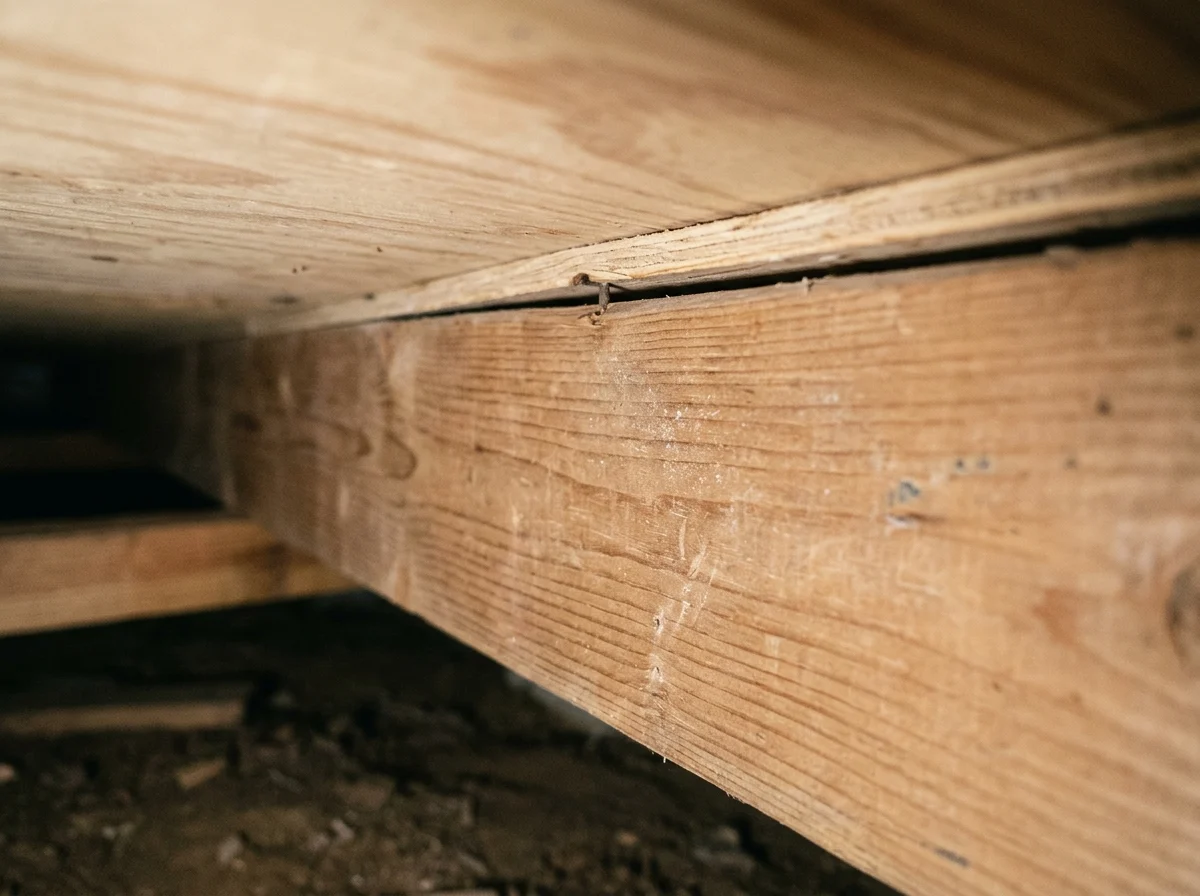
What's actually causing the squeak
A squeak is friction between two things that used to sit still against each other. Here's what we look for underneath to find out why they're moving now.
Subfloor pulling away from the joists
A support post or girder settling underneath
Humidity swings in the crawl space
Not sure which one you have? That's exactly why we diagnose first.
How much a squeaky floor actually matters
Most squeaks are just noise. The ones that matter are the ones that are spreading or getting worse.
Caught early: a quick, contained fix
If it's a single loose spot or one support just starting to move, we can usually re-secure the subfloor or shore up that one weak post from below, without opening up your finished floors.
Left alone: it keeps spreading
A squeak that's traveling to new spots means the movement causing it hasn't stopped. Left alone, it typically turns into visible sag or bounce, and the fix ends up covering more of the floor, not just one board.
How we quiet a squeaky floor for good
The right fix depends on whether it's isolated or spreading, and whether a support underneath is already failing. We prescribe the one that matches what's actually happening, not the biggest job on the list.
Sagging Floor Repair
We re-secure and support the floor framing from the crawl space, so the subfloor stops shifting against the joists that are causing the noise.
Best for: Floors with squeaks that come with any dip, softness, or bounce, a sign the frame underneath has already started to move.
Crawl Space Support Repair
New posts, beams, or footings placed exactly where a support has weakened, before any sag is visible from inside the house.
Best for: A cluster of new squeaks in one specific area, with no visible sag yet from above.
When it's just an old floor
Some squeaks in an older home are just wood doing what wood does. If that's what we find, we'll tell you, not sell you a repair you don't need.
Best for: A few steady squeaks in the same one or two spots for years, with nothing new joining in and no sag nearby.
We diagnose. We prescribe. We treat.
A lot of foundation repair companies show up to sell you the most expensive thing they install. We show up to figure out what's actually wrong under your home first, then prescribe the repair that fixes it, and tell you straight, even when the answer is "you don't need as much as you were told." That's the difference between a sales call and a diagnosis.
Diagnose
A free in-home inspection by someone who does this work, not a commission salesperson. We look at the real signs, inside and underneath, and walk you through what's actually causing the movement. You get a clear, honest read on where your home stands.
Prescribe
We lay out the right fix for what's actually wrong, not the priciest line item. A plain-English explanation, a fair price in writing, and the warranty terms with it. We go over the plan and your options, and you decide on your own time. No "today only" pressure.
Treat
Dependable work by our own local crew, on time, cleaned up after themselves, and finished on or ahead of schedule, the way our customers describe it. We keep you in the loop the whole way, and we stand behind the work for the life of the structure.
Most foundation companies sell you a fix. We diagnose first, then prescribe only what your home actually needs. That's the difference between an honest local team and a sales quota from out of town.
Squeaks rarely show up by themselves
The same subfloor and support movement that causes squeaking usually leaves other clues around the house. If any of these look familiar too, they point to the same diagnosis.
Sagging or bouncy floors
Rotted floor joists
Gaps between floor and baseboard
Not sure which one you have? That's exactly why we diagnose first.
Straight answers about squeaky floors
Get a straight answer on your squeaky floors, free.
You won't get a sales pitch. You'll get someone under your house checking the actual subfloor and supports, a plain-English read on whether it's normal wear or something worth fixing, and a fair price in writing if it is.