What you're seeing
What a failing floor system feels like
Floors give you more warning than almost any other part of the house. These are the signs homeowners describe to us most often.
What's giving out underneath
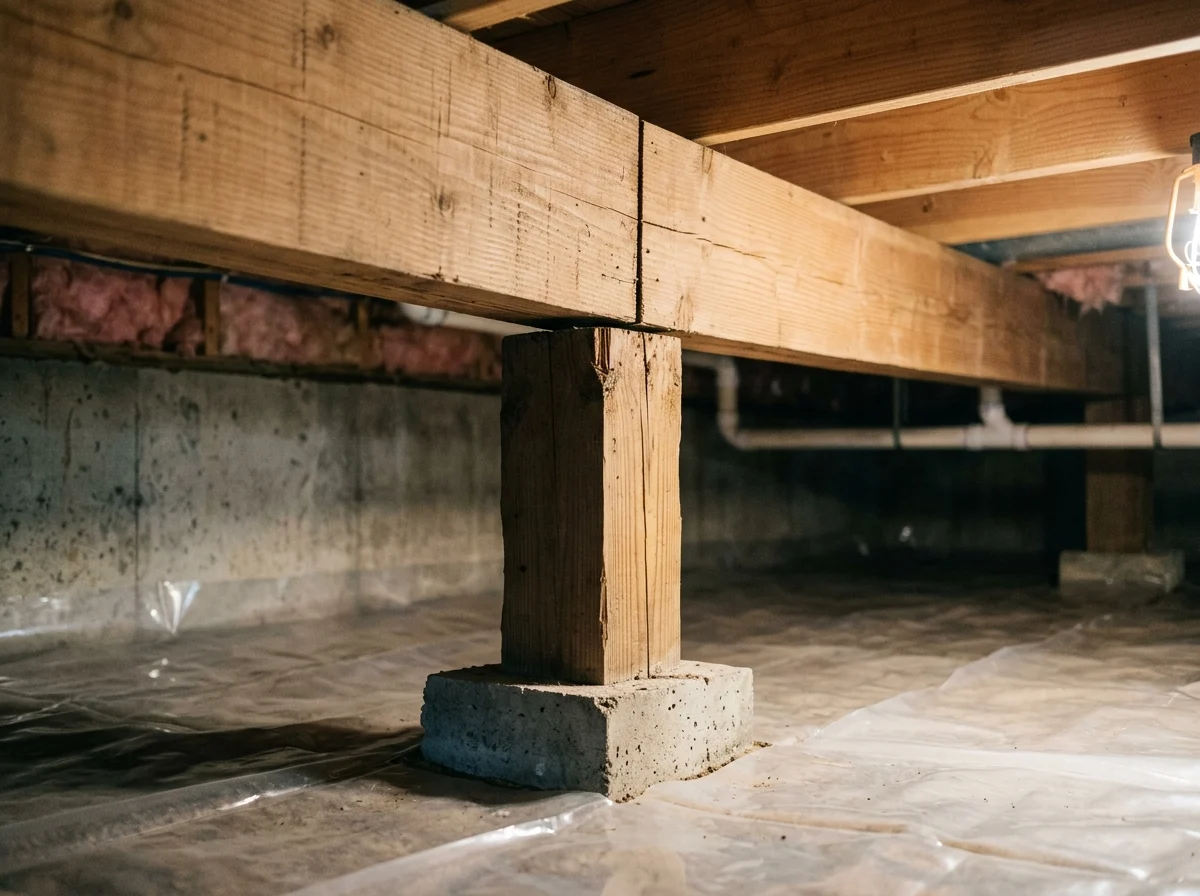
Your floor framing is usually fine. What is holding it up is not. Here is what we go under the house to look at.
Failing posts and girders
Moisture and wood rot
Undersized or over-spanned framing
Not sure which one you have? That's exactly why we diagnose first.
Support problems and rot problems cost differently
The line between them is moisture. That is why we look at the wood and the water on the same visit.
Support it and you're done
A floor that has just started to dip is usually a support problem, not a rot problem. New posts, beams, and proper footings under the existing joists put it back on solid footing without opening up your finished floors.
It turns into a rebuild
Once joists and subfloor rot through, adding support underneath is not enough. The framing itself has to be replaced, which means tearing out flooring and real disruption in your house. Moisture is what gets you there, and moisture does not stop on its own.
How we put your floor back on solid support
How much work it takes comes down to whether the wood is still sound. We tell you which one you have before we quote it, not after.
Sagging Floor Repair
Adjustable steel supports, new posts, and proper footings under the girder line take the sag out and hold the floor where it belongs. Where the framing allows, we can recover some of the dip over time.
Best for: Floors that are dipping or bouncing where the framing is still sound.
Floor Rebuilds
Where joists, girders, or subfloor have rotted past saving, we replace the framing itself and put the floor back on new wood that will carry the load.
Best for: Floors with soft spots, visible rot, or framing that has already failed.
Fixing the moisture with it
If damp crawl space air caused the rot, the repair will not hold unless the water is handled too. That is a straight conversation at the inspection, not an upsell after the fact.
Best for: Any sagging floor over a damp or unsealed crawl space.
We diagnose. We prescribe. We treat.
A lot of foundation repair companies show up to sell you the most expensive thing they install. We show up to figure out what's actually wrong under your home first, then prescribe the repair that fixes it, and tell you straight, even when the answer is "you don't need as much as you were told." That's the difference between a sales call and a diagnosis.
Diagnose
A free in-home inspection by someone who does this work, not a commission salesperson. We look at the real signs, inside and underneath, and walk you through what's actually causing the movement. You get a clear, honest read on where your home stands.
Prescribe
We lay out the right fix for what's actually wrong, not the priciest line item. A plain-English explanation, a fair price in writing, and the warranty terms with it. We go over the plan and your options, and you decide on your own time. No "today only" pressure.
Treat
Dependable work by our own local crew, on time, cleaned up after themselves, and finished on or ahead of schedule, the way our customers describe it. We keep you in the loop the whole way, and we stand behind the work for the life of the structure.
Most foundation companies sell you a fix. We diagnose first, then prescribe only what your home actually needs. That's the difference between an honest local team and a sales quota from out of town.
Sagging floors rarely travel alone
What is happening under the floor usually shows up somewhere you can see. If any of these look familiar, they belong in the same diagnosis.
Wet or musty crawl space
Sticking doors & windows
Cracks in drywall or trim
Not sure which one you have? That's exactly why we diagnose first.
Straight answers about floors that sag and bounce
Get a straight diagnosis on your floors, free.
You won't get a sales pitch. You'll get someone under your house looking at the actual posts, beams, and joists, a plain-English read on whether it's support or rot, what it takes to fix it, and a fair price in writing.